Your Website Is Not Just a Digital Visiting Card: How to Turn Visitors into Customers
Your website should do more than showcase your business. Discover how to turn website visitors into potential customers using engaging content, strong calls to action, service pages, enquiry forms and an effective digital marketing strategy.
Your Website Is Not Just a Digital Visiting Card: How to Turn Visitors into Customers
In today's competitive digital world, having a website is no longer enough. Thousands of businesses have websites, but many struggle to convert visitors into actual customers.
A professional website should do more than display your company name, logo, services and contact details. It should communicate your value, build trust, answer customer questions and encourage visitors to take action.
Whether you operate a startup, consultancy, agency, local business or established company, your website can become an important part of your business growth strategy.
Let's understand how to turn your website into a customer-generation platform.
1. Create a Strong First Impression
When someone visits your website, they should immediately understand what your business offers.
Your homepage should clearly communicate:
What your business does
Which products or services you provide
Who your target customers are
Why customers should choose you
How visitors can contact you
Use professional images, clear headings and simple navigation to make the website experience more effective.
2. Build Service Pages That Answer Customer Questions
Many businesses make the mistake of describing all their services on a single page.
Instead, create dedicated service pages that explain each offering in detail.
For example, a digital marketing company can create separate pages for:
Search Engine Optimization
Social Media Marketing
Website Development
Google Ads Management
Lead Generation
Content Marketing
Each page should explain the service, its benefits, the target audience and how customers can get started.
3. Use Powerful Call-to-Action Buttons
A website visitor needs a clear reason to take the next step.
Add action-oriented buttons in relevant sections.
Examples include:
Get a Free Consultation
Request a Quote
Book a Free Demo
Contact Our Team
Get Started Today
Enquire Now
Make sure these buttons lead to the correct contact form, booking page or communication channel.
4. Make Your Website Mobile-Friendly
Most customers use smartphones to search for products, services and businesses.
If your website is difficult to navigate on a mobile device, visitors may leave without contacting you.
A mobile-friendly website should have:
Responsive page layouts
Readable text
Easy navigation
Properly sized buttons
Optimized images
Fast loading performance
Always test your website on different screen sizes.
5. Build Customer Trust Through Content
People are more likely to contact businesses they trust.
Your website should include information that helps visitors understand your business and expertise.
Consider adding:
About Us information
Customer testimonials
Case studies
Project portfolios
Frequently asked questions
Business address and contact information
Certifications and achievements, where applicable
Useful content helps customers make informed decisions.
6. Use SEO to Attract the Right Visitors
Search Engine Optimization helps your website become more discoverable through search engines.
However, attracting traffic is only part of the process. You also need relevant visitors who are interested in your products or services.
Important SEO activities include:
Keyword Research: Identify what your potential customers search for.
On-Page SEO: Optimize page titles, headings, descriptions and content.
Technical SEO: Improve website performance, indexing and mobile usability.
Content Marketing: Publish informative blogs that answer customer questions.
Local SEO: Improve visibility for location-based searches.
A well-planned SEO strategy can help attract relevant visitors over time.
7. Use GEO to Improve AI Search Visibility
Search behaviour is evolving with AI-powered search engines and answer platforms.
Generative Engine Optimization (GEO) focuses on making your business information and website content easier for AI-powered systems to understand and potentially reference.
To strengthen your GEO strategy:
Publish original and informative content.
Answer common customer questions.
Use clear headings and structured information.
Include accurate business information.
Build relevant industry expertise.
Keep website content updated.
Combining SEO and GEO can help businesses prepare for changing search experiences.
8. Make It Easy for Customers to Contact You
A visitor may be interested in your service but leave if contacting your business is difficult.
Provide convenient communication options, such as:
Contact forms
WhatsApp links
Click-to-call phone numbers
Business email addresses
Enquiry buttons
Keep the enquiry process simple and ask only for the information you actually need.
9. Connect Website Traffic With Lead Generation
Website traffic becomes more valuable when you have a process for handling enquiries.
A simple customer journey can look like this:
Website Visitor
Discovers your business onlineService or Landing Page
Understands your products and servicesEnquiry / Contact Form
Shares contact informationFollow-up
Business connects with the potential customerCustomer Conversion
Potential customer becomes a customerThis process helps businesses understand how website visitors can become genuine sales opportunities.
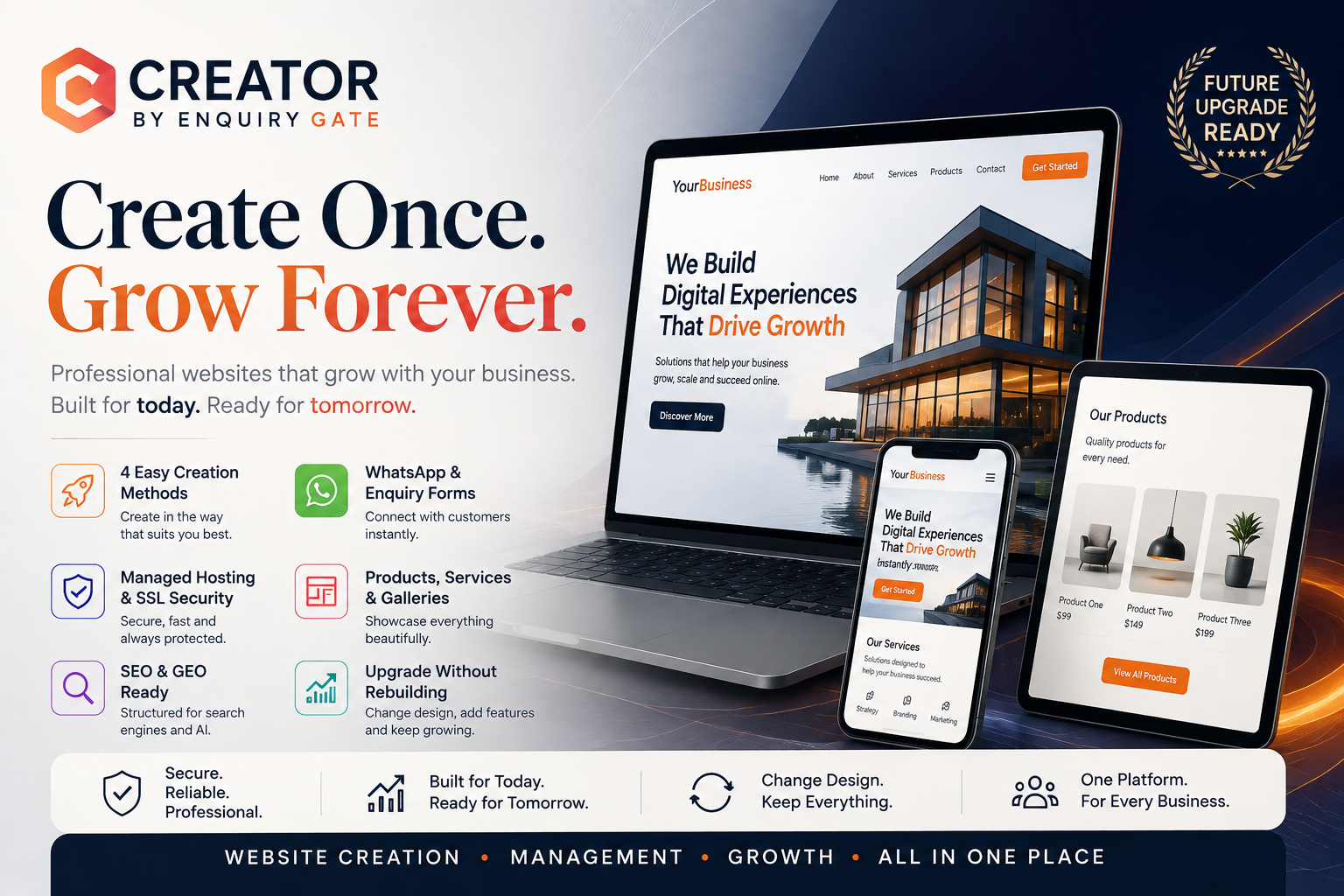
10. Why Choose Creator by EnquiryGate?
Creator by EnquiryGate helps businesses establish and manage their online presence through two website creation approaches.
Template-Based Website Creation
Business owners can provide their business information, brochures, text and photos or fill out a simple form. They can then manage their website through a dynamic editor and full website administration system.
Prompt-Based Website Creation
Professionals can start with a written prompt or visual reference to develop custom websites, applications and software concepts.
Creator aims to make website creation more accessible for entrepreneurs, startups and growing businesses.
Explore: https://creator.enquirygate.com/
Conclusion
Your website should not simply exist on the internet. It should actively support your business objectives.
A well-designed website with useful content, SEO optimization, clear calls to action and easy enquiry options can help you build trust and create more opportunities to connect with potential customers.
Stop thinking of your website as just a digital visiting card.
Start thinking of it as an important part of your business growth strategy.
Build your professional website with Creator by EnquiryGate and take your business online.
Create. Connect. Convert. Grow.